
ACL Surgery Rehabilitation: What Runners Get Wrong | Physora Physio Neath
Discover what most runners and athletes get wrong about ACL surgery rehabilitation. Evidence-based physiotherapy guidance from Physora Physio in Neath.
Paul Antony
6/1/20266 min read
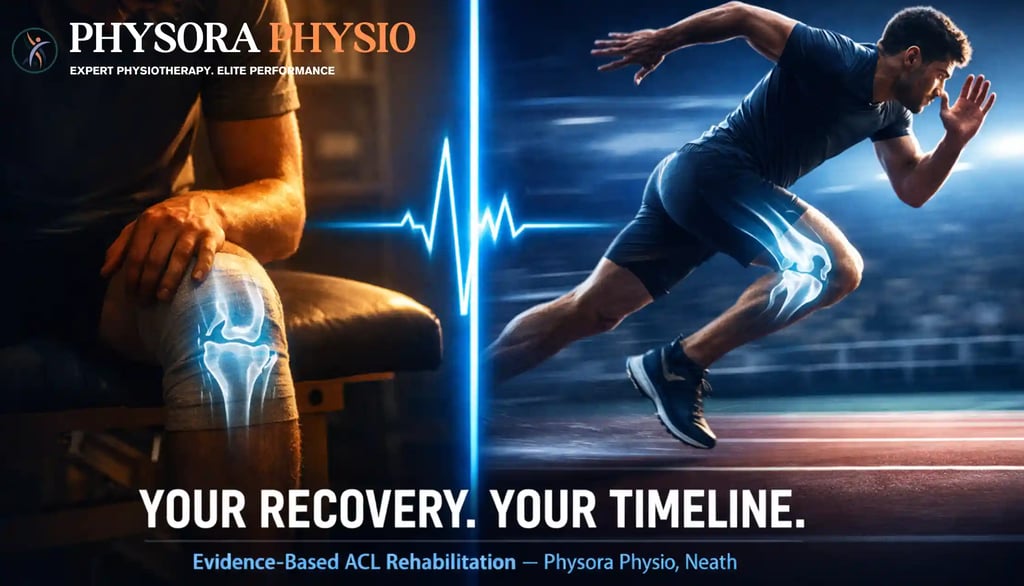

ACL Surgery Rehabilitation: What Most Runners and Athletes Get Wrong About Recovery
Why Some People Return Stronger… While Others Struggle for Months
By Physora Physio · Sports Physiotherapy · Knee Rehabilitation
You finally had the surgery. The swelling is settling, the crutches are gone, and people keep telling you that you'll be back in no time. But deep down, something about your ACL surgery rehabilitation journey still feels uncertain.
Your knee feels stiff. Stairs feel awkward. Running feels impossible to imagine. And every small twist or wobble makes you wonder: What if I never trust this knee again?
At Physora Physio in Neath, we regularly work with runners, footballers, gym-goers, and active adults who expect ACL recovery to be straightforward — only to discover that rehabilitation is where the real challenge begins.
The good news? Evidence-based sports physiotherapy after ACL surgery can dramatically improve strength, confidence, movement quality, and return-to-sport outcomes — but only when the right rehab is applied at the right time.
What Actually Happens to Your Knee After ACL Surgery?
The anterior cruciate ligament (ACL) helps stabilise the knee during twisting, cutting, sprinting, landing, and sudden changes in direction. After surgery, the new graft needs time to heal and integrate biologically into the surrounding tissue — but healing alone is not enough for a full, safe return to sport.
Research published in leading sports medicine journals over the last decade consistently shows that successful physiotherapy after ACL surgery depends on several interconnected factors:
Restoring quadriceps strength to match the uninjured leg
Improving balance and neuromuscular control
Rebuilding movement confidence and psychological readiness
Gradually reintroducing impact and sport-specific loading
Addressing fear of reinjury at every stage of ACL recovery
Systematic reviews and clinical guidelines published after 2018 consistently indicate that many athletes return to sport before their strength and movement quality are fully restored — a pattern that may significantly increase reinjury risk. That is why modern ACL surgery rehabilitation is far more than a collection of exercises. It is a structured, progressive rebuilding process that addresses the whole person.
The Biggest Mistake People Make During ACL Rehabilitation
One of the most common mistakes we see at Physora Physio is patients focusing entirely on time rather than readiness. People often ask: "How many months until I can run again?" But evidence-based ACL rehabilitation focuses more on objective criteria than the calendar.
Two patients who are both six months post-operation may be in completely different stages of recovery. One may have excellent single-leg strength, good landing control, confidence during direction changes, and minimal swelling. The other may still have significant quadriceps weakness, knee stiffness, poor balance, and pain during hopping or jogging.
What modern evidence says: Clinical practice guidelines now recommend using objective strength testing, functional movement assessments, and symptom response — not time alone — to guide progression through ACL surgery rehabilitation.
This criteria-based approach means your physiotherapist assesses how ready your body is, not simply how many weeks have passed since your operation. For a broader look at how this applies to knee injuries in sport, see our guide to sports knee injury recovery.
Why Quadriceps Strength Matters More Than Most People Realise in ACL Recovery
After ACL surgery, the quadriceps muscles often weaken dramatically — and this matters enormously for long-term outcomes. Recent systematic reviews have linked persistent quadriceps weakness with reduced athletic performance, altered movement mechanics, ongoing knee pain, lower confidence, and increased reinjury risk.
This is why early-stage ACL rehabilitation commonly prioritises:
Restoring full knee extension range of motion
Controlled progressive strength work targeting the quadriceps
Graduated loading through targeted knee physiotherapy exercises
Neuromuscular activation to retrain how the muscles fire and stabilise the joint
At Physora Physio in Neath, we explain it this way: your ACL graft may heal biologically, but your body still needs to relearn how to absorb force, stabilise the joint, and trust movement again. Quadriceps strength is the foundation on which every subsequent stage of ACL recovery is built.
The Emotional Side of ACL Surgery Rehabilitation Nobody Talks About
One of the most overlooked dimensions of physiotherapy after ACL surgery is the psychological impact of the injury and recovery process. Fear is incredibly common — fear of twisting, sprinting, landing awkwardly, or going through surgery all over again. Research in sports psychology and rehabilitation science consistently shows that psychological readiness plays a major role in successful return to sport after ACL reconstruction.
Some athletes are physically strong enough to return to sport, but mentally hesitate during movement. Others feel pressure to rush back early because of:
Team or competition expectations
Social media comparisons with other people's recovery timelines
Upcoming events or key fixtures
General frustration with the pace of recovery
Effective ACL surgery rehabilitation must include graded exposure to movement, systematic confidence rebuilding, and realistic progression that accounts for both the physical and psychological dimensions of recovery — not just a sheet of exercises to follow at home.
A Recovery Story Many Active Adults Relate To
Sarah, a fictional 29-year-old recreational runner from near Neath, had ACL reconstruction surgery after sustaining a football injury. At four months post-operation, she became increasingly frustrated after seeing social media videos of others "already back running."
When assessed properly, Sarah still presented with significant single-leg strength deficits, poor landing control, swelling after longer walks, and fear during direction changes. Rather than rushing her return to sport, her ACL recovery programme focused on:
Progressive quadriceps strength training with measurable milestones
Plyometric preparation and landing mechanics retraining
A structured running progression guided by criteria, not calendar dates
Gradual impact exposure alongside confidence-rebuilding work
Several months later, Sarah returned to running, feeling stronger and more confident in her knee than she had before her injury.
The patient's story is a fictional example created for educational purposes, based on common physiotherapy scenarios.
What Evidence-Based ACL Surgery Rehabilitation Actually Includes
Every ACL rehabilitation plan should be individually tailored, but modern evidence-based programmes typically follow a phased, criteria-driven structure. Clinical practice guidelines published in the British Journal of Sports Medicine and the Journal of Orthopaedic & Sports Physical Therapy support progressive, criteria-based physiotherapy after ACL surgery combined with strength and neuromuscular training.
Early Phase
Swelling management
Restoring knee extension
Walking mechanics
Basic strength activation
Pain-guided movement
Middle Phase
Progressive strength training
Single-leg control
Balance and stability work
Cardiovascular conditioning
Movement retraining
Late Phase
Plyometrics
Running progression
Deceleration drills
Agility and direction changes
Sport-specific rehabilitation
Understanding which phase you are in and what criteria you need to meet before progressing is central to reducing reinjury risk and building genuine confidence in your knee. For more on how we structure this progression, read about our sports physiotherapy services in Neath.
When Should You Seek Professional Physiotherapy After ACL Surgery?
You should consider working with a specialist sports physiotherapist if any of the following apply to you:
You still feel unstable or lack trust in your knee after surgery
You have ongoing swelling or stiffness that is not improving
You feel stuck or uncertain about your progress in ACL recovery
You want to return to running, football, or sports safely and with confidence
You are unsure whether you are progressing normally
You experience pain during impact activities such as jogging or jumping
Trying to push through without proper guidance can delay recovery or increase frustration. A structured ACL surgery rehabilitation plan provides clear milestones, objective assessments, and a personalised roadmap from surgery to full activity.
Why Personalised Physiotherapy in Neath Makes a Difference
No two ACL recoveries are identical. Your goals, sport, training history, movement patterns, and confidence levels all influence what effective rehabilitation looks like for you. At Physora Physio, our approach to ACL surgery rehabilitation in Neath centres on:
Evidence-based sports physiotherapy with objective, criteria-driven progression
Progressive strength and movement rehabilitation tailored to your personal goals
Running analysis and structured return-to-sport guidance
Individualised rehabilitation planning for each phase of ACL recovery
Education, expectation-setting, and ongoing confidence-building throughout
Whether your goal is returning to football, running around Gnoll Estate Country Park, or simply trusting your knee again on everyday walks, physiotherapy after ACL surgery should feel purposeful, progressive, and designed for your life.
Learn more about related conditions we treat on our knee physiotherapy page, or explore our running injury prevention guide for athletes returning to training.
Frequently Asked Questions About ACL Surgery Rehabilitation
How long does ACL surgery rehabilitation take?
ACL surgery rehabilitation timelines vary considerably between individuals. Most programmes last 9–12 months depending on strength, symptoms, sport demands, and personal goals. Current evidence increasingly supports criteria-based progression over fixed timelines, meaning your readiness to return to sport is measured by objective strength and movement tests rather than the number of months since your operation.
When can I run after ACL surgery?
Return to running after ACL surgery typically begins several months post-operation, but exact timing depends on individual factors including quadriceps strength, swelling, pain levels, movement quality, and functional test results. Your physiotherapist will assess your readiness using objective criteria before introducing a running progression.
Is swelling normal after ACL surgery?
Some swelling is common during ACL recovery, particularly after increased levels of activity. However, persistent or worsening swelling should always be assessed by a physiotherapist, as it may indicate you are progressing too quickly or that further evaluation is needed.
Can physiotherapy reduce ACL reinjury risk?
Evidence suggests that structured ACL surgery rehabilitation focusing on quadriceps strength, neuromuscular control, landing mechanics, and gradual return-to-sport progression may significantly help reduce reinjury risk. Criteria-based physiotherapy that addresses both physical and psychological readiness is associated with improved long-term outcomes.
Why does my knee still feel weak months after ACL surgery?
Quadriceps weakness and altered movement patterns can persist for many months after ACL surgery, even when the graft has healed biologically. Targeted physiotherapy after ACL surgery focusing on progressive strength training, neuromuscular activation, and movement retraining is typically required to fully restore strength and confidence in the knee.
Evidence Base
This article is informed by:
Clinical practice guidelines for ACL rehabilitation
Systematic reviews on quadriceps strength and return-to-sport outcomes
Consensus statements on criteria-based return-to-sport testing
Research in sports psychology and ACL recovery
Sports medicine literature published after 2011, including evidence from the British Journal of Sports Medicine, Journal of Orthopaedic & Sports Physical Therapy, and Sports Medicine
Ready to Rebuild Confidence in Your Knee?
ACL recovery can feel physically and emotionally exhausting. But with the right rehabilitation approach, many people return stronger, more resilient, and more confident than before their injury.
If you are recovering from ACL surgery and want evidence-based sports physiotherapy in Neath, Physora Physio can help guide your recovery with a personalised rehabilitation plan.


Copyright © 2025 Physora Physio
Useful links
PHYSORA PHYSIO
Expert Physiotherapy.
Elite Performance
Get in Touch
Treatments
Plan Your Visit
About Us
Insights