
Why Early Rehabilitation Matters After Knee Replacement | Physora Physio
Discover why early physiotherapy after knee replacement speeds recovery, protects range of motion, and reduces complications. Expert guidance from Physora Physio, Neath.
Paul Antony
7/27/20265 min read
Why Early Rehabilitation Is Essential After Knee Replacement Surgery
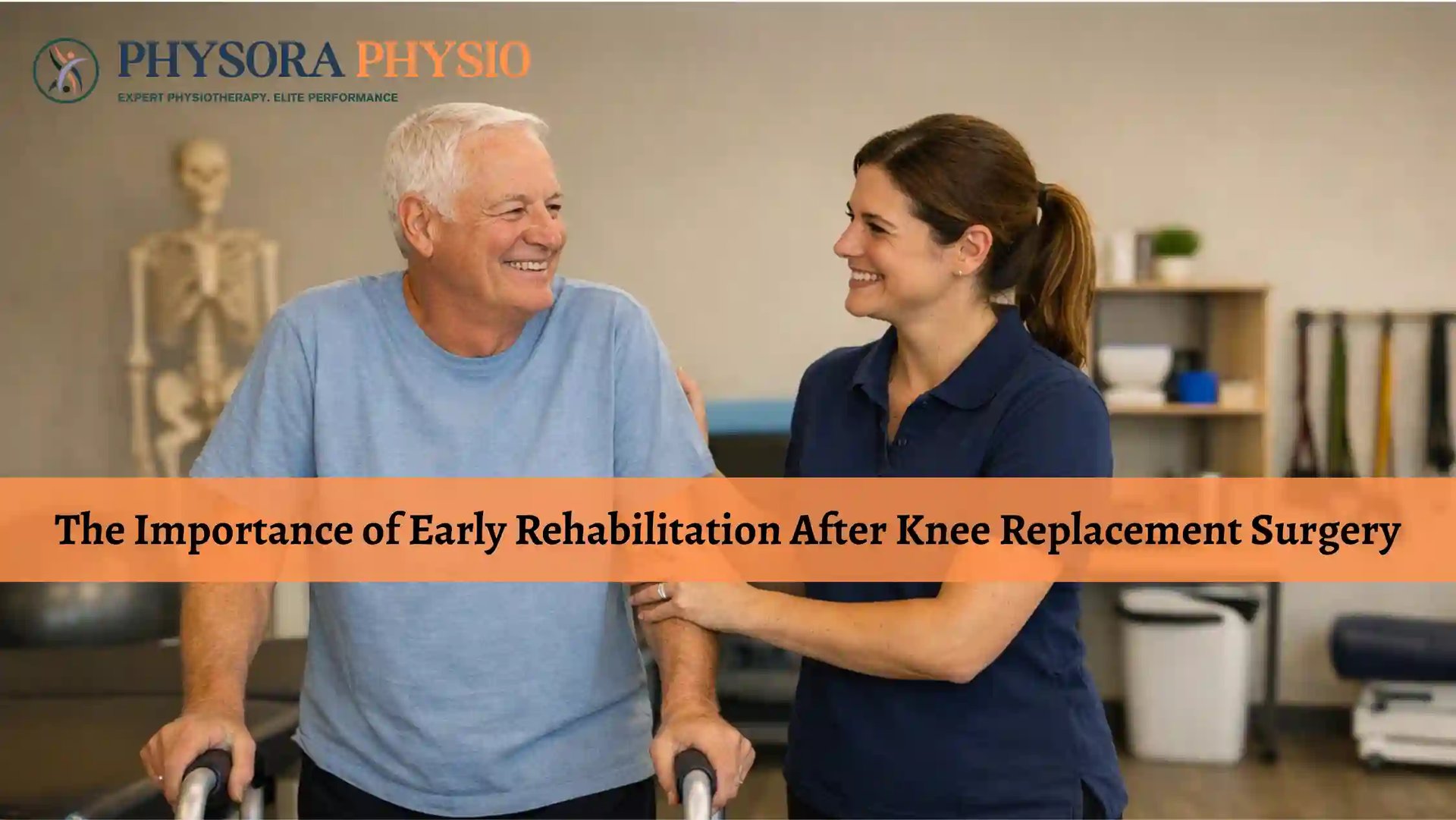
Margaret, 68, had waited over a year for her knee replacement. By the time surgery day arrived, she was relieved but also terrified of what came next. “Everyone told me it would hurt,” she said. “So on day one, I just wanted to stay still.” Her physiotherapist gently encouraged her to sit up, then stand, within hours of leaving theatre. Margaret was sceptical. Six weeks later, walking unaided around her garden, she understood why that first short walk mattered more than almost anything else in her recovery.
Margaret’s hesitation is completely understandable and extremely common. But it also highlights one of the most important, evidence-backed principles in orthopaedic recovery: the sooner you begin moving safely after knee replacement surgery, the better your outcomes tend to be.
Patient story is a fictional example created for educational purposes, based on common physiotherapy scenarios
What Happens to Your Knee After Replacement Surgery
A total knee replacement (TKA) involves resurfacing the damaged joint with metal and plastic components. The surgery itself is only the starting point — the muscles around your knee, particularly the quadriceps, become inhibited almost immediately after surgery due to swelling, pain signalling, and tissue trauma. Left unaddressed, this inhibition compounds quickly: stiffness builds, scar tissue begins forming around a joint that isn’t moving through its full range, and confidence in weight-bearing drops the longer it’s avoided.
This is why physiotherapy after knee replacement isn’t simply “recommended” — it is a core part of the treatment itself, not an optional add-on once the surgical wound has healed.
Why the First 24–48 Hours Matter So Much
Historically, patients were kept resting in bed for several days after joint replacement. Current evidence points firmly in the opposite direction.
A systematic review of randomised controlled trials found that patients who mobilised — sitting out of bed and walking — within 24 hours of hip or knee replacement had hospital stays roughly 1.8 days shorter than those on traditional, delayed protocols, with no increase in complications or adverse events. Separate research comparing rehabilitation starting within 24 hours versus a 48–72 hour delay found the early group had better early range of motion, less pain, and greater knee strength. A large multicentre study in China reinforced this, linking ambulation within 24 hours of surgery to improved early functional recovery.
The theme across this research is consistent: early movement, done safely and under guidance, protects the gains your surgeon has just created.
What Early Rehabilitation Actually Looks Like
Early rehabilitation is not about rushing or “pushing through” — it is structured, supervised, and paced to your body’s healing.
In the first hours to days, this typically includes: - Sitting up and standing with support - Short, assisted walks using a frame or crutches - Gentle active and passive knee bending and straightening - Quadriceps activation exercises to “wake up” the muscle - Swelling and pain management strategies - Education on safe movement patterns for getting in/out of bed or a chair
As healing progresses over the following weeks, physiotherapy shifts toward restoring full range of motion, rebuilding strength in the quadriceps, hamstrings, and hip muscles, and retraining a normal walking pattern — often incorporating balance and functional tasks like stairs and sit-to-stand practice.
What Happens If Rehabilitation Is Delayed
A systematic review and meta-analysis specifically looking at early supervised exercise programmes found the picture is more nuanced: while some trials showed superior early knee flexion with earlier, more intensive programmes, this difference wasn’t statistically significant by the six-week mark in pooled analysis — a reminder that not every recovery detail is settled science, and results vary between studies.
What the broader evidence base agrees on is this: delaying general mobilisation — staying in bed longer than necessary, avoiding walking, or skipping early physiotherapy input — is associated with longer hospital stays, slower functional recovery, and a higher risk of stiffness that becomes harder to resolve the longer it’s left. Knee flexion in particular can be difficult to regain if scar tissue and swelling are allowed to settle around a joint that isn’t being moved regularly.
Recovery Expectations: A Realistic Timeline
Every patient’s recovery differs based on pre-surgery fitness, surgical approach, and general health, but a typical pattern looks like this:
Weeks 0–2: Focus on wound healing, swelling control, walking with an aid, and regaining basic movement
Weeks 2–6: Outpatient physiotherapy typically begins or intensifies; walking aids are gradually reduced; strength work increases
Weeks 6–12: Continued strengthening, balance work, and return to most daily activities
Months 3–4 onwards: Most patients reach close to their maximum range of motion, generally aiming for full straightening and around 120 degrees of bend, though this varies by individual
These are general guides, not guarantees — your physiotherapist will set milestones specific to your knee, your goals, and your progress.
Preventing Setbacks and Protecting Your New Knee
Keep up with your prescribed home exercise programme, even on days you feel well
Don’t skip scheduled physiotherapy reviews — small issues are far easier to correct early
Manage swelling proactively with elevation and guided exercise, rather than rest alone
If you’re still awaiting surgery, ask about prehabilitation — building strength and movement quality beforehand can support an easier recovery afterwards
Report any sudden increase in pain, redness, warmth, or swelling to your surgical team promptly
When to Seek Professional Physiotherapy Support
You should seek physiotherapy guidance as early as possible after surgery — ideally starting within the hospital and continuing seamlessly into outpatient care. Contact a physiotherapist or your surgical team without delay if you notice worsening pain rather than gradual improvement, a hot or increasingly swollen knee, signs of a wound infection, calf pain or swelling (a possible sign of blood clot), or if your range of motion seems to be getting worse rather than better over successive weeks.
Frequently Asked Questions
How soon after knee replacement should I start physiotherapy?
Most current evidence supports beginning gentle mobilisation within 24 hours of surgery, guided by hospital physiotherapy staff, followed by structured outpatient rehabilitation once discharged.
Is it normal for physiotherapy to be painful after knee replacement?
Some discomfort during movement and stretching is expected, but physiotherapy should be closely monitored and paced to your pain tolerance — it should never involve pushing through severe or sharp pain.
How long until I can walk normally after knee replacement?
Many patients walk with an aid within days and transition off aids within a few weeks, though a fully normal gait pattern can take several months of consistent rehabilitation.
Can I do physiotherapy at home instead of in a clinic?
Home exercises are an important part of recovery, but professional, hands-on physiotherapy input — particularly in the early weeks — helps ensure correct technique, appropriate progression, and early identification of any complications.
Take the Next Step in Your Recovery
Recovering well from knee replacement surgery isn’t just about time — it’s about the right guidance at the right stage. At Physora Physio, our physiotherapists provide structured, assessment-led post-surgical rehabilitation for patients across Neath, Bryncoch, and Skewen, helping you move confidently from hospital discharge through to full recovery.
👉 Book your post-surgical physiotherapy assessment with Physora Physio in Neath today.
References
Aftab, A., et al. (2025). Early physiotherapy for post-total knee arthroplasty recovery: A systematic review of randomised controlled trials. Musculoskeletal Care.
Guerra, M. L., Singh, P. J., & Taylor, N. F. (2015). Early mobilisation of patients who have had a hip or knee joint replacement reduces length of stay in hospital: A systematic review. Clinical Rehabilitation.
Haas, R., Sarkies, M., Bowles, K. A., et al. (2016). Early commencement of physical therapy in the acute phase following elective lower limb arthroplasty produces favourable outcomes: A systematic review and meta-analysis. Osteoarthritis and Cartilage.
Harikesavan, K., Chakravarty, R. D., & Maiya, A. G. (2019). Influence of early mobilisation program on pain, self-reported and performance-based functional measures following total knee replacement. Journal of Clinical Orthopaedics and Trauma.
Lei, Y. T., Xie, J. W., Huang, Q., et al. (2021). Benefits of early ambulation within 24 h after total knee arthroplasty: A multicentre retrospective cohort study. Military Medical Research.


Copyright © 2025 Physora Physio
Useful links
PHYSORA PHYSIO
Expert Physiotherapy.
Elite Performance
Get in Touch
Treatments
Plan Your Visit
About Us
Insights