
Can't Straighten Your Knee After ACL Surgery? Here's Why | Physora Physio
Struggling to fully straighten your knee after ACL reconstruction? Discover the evidence-based causes, what's normal, and how Physora Physio (Neath) can help.
Paul Antony
7/19/20266 min read
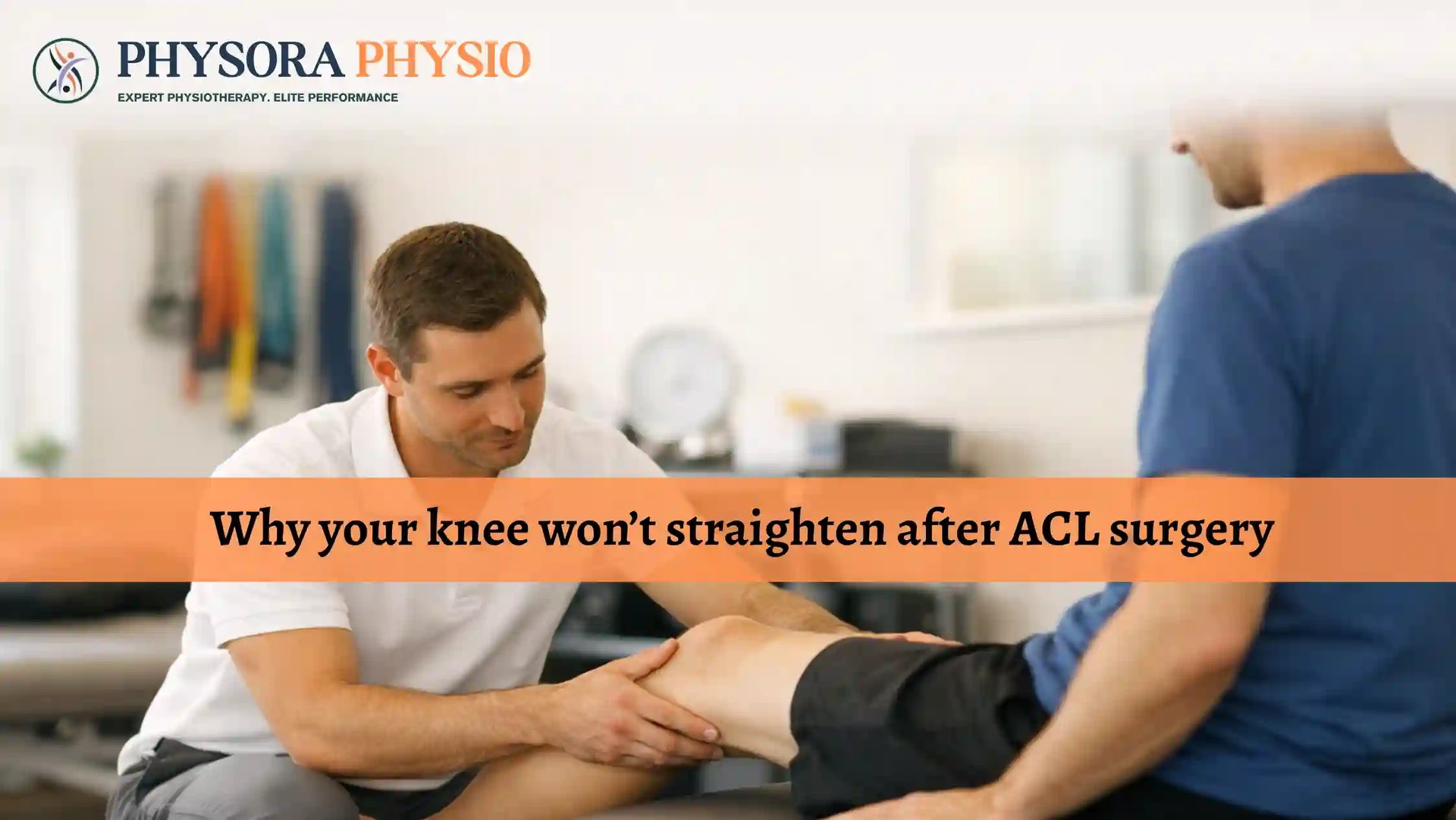
Why Can't I Fully Straighten My Knee After ACL Reconstruction?
Ten weeks after ACL reconstruction, "Danny," a 27-year-old five-a-side footballer from Neath, could jog, could bend his knee past 120 degrees, and had ticked off most of his rehab milestones except one. He couldn't get his knee to lock out straight. Every time he tried, there was a stubborn, springy resistance a few degrees short of full extension. He assumed it would "just sort itself out." When it hadn't budged by week twelve, he started to worry something had gone wrong with the surgery itself.
Danny's experience is common, and it's one of the most misunderstood parts of ACL recovery. Most patients (and even some clinicians early in their careers) focus almost entirely on regaining bend, because it's the more visible, more talked-about milestone. But a knee that won't fully straighten is not a minor cosmetic issue. It's a specific, well-documented complication with its own causes, its own evidence base, and its own treatment pathway.
The patient's story is a fictional example created for educational purposes, based on common physiotherapy scenarios.
What "Normal" Knee Extension Recovery Looks Like
A healthy, uninjured knee sits in roughly zero degrees of extension, fully straight, sometimes with a small amount of natural hyperextension. After ACL reconstruction, some early stiffness and swelling are expected in the first one to two weeks. What isn't expected, according to the physiotherapy literature, is for that stiffness to persist much beyond the early post-operative window.
This matters because knee stiffness after ACL reconstruction, measured as either a loss of extension, a loss of flexion, or both, is a recognised complication, not a rare fluke. Research examining this specifically has found reported rates of knee stiffness after ACL reconstruction varying widely, from around 2% up to as high as 35%, depending on how "stiffness" is defined and when it's measured. Loss of extension specifically has been reported at meaningfully high rates in some cohorts, particularly in the first month after surgery, which is exactly why physiotherapists now treat early extension as a non-negotiable early milestone rather than something to "work up to."
The Main Reasons Your Knee Won 't Fully Straighten
There isn't one single cause of extension loss after ACL reconstruction; there are several, and identifying which one (or combination) applies to you is the first job of a good rehabilitation assessment.
1. Post-surgical swelling and quadriceps inhibition
Swelling inside the joint (an effusion) mechanically limits how far the knee can straighten, and it also triggers a reflex inhibition of the quadriceps muscle, meaning the muscle that should be locking your knee out straight simply doesn't fire properly while swelling is present. This is one of the most common and most fixable early causes, and it responds well to targeted swelling management and quadriceps activation work.
2. Scar tissue and arthrofibrosis
In some patients, the body lays down excess scar tissue inside and around the joint during healing, a condition known as arthrofibrosis. This can restrict the joint's ability to move through its full range in either direction, but extension is typically affected first and most noticeably.
3. Cyclops lesion (graft impingement)
A cyclops lesion is a small, fibrous nodule of tissue that can form at the front of the new ACL graft, physically blocking the knee from straightening fully, much like a doorstop wedged in a door hinge. It's a well-recognised, specific cause of extension loss following ACL reconstruction, often associated with a firm, mechanical "block" (rather than a springy, stretchy resistance) and sometimes an audible or palpable clunk as the knee is extended. Reported rates vary meaningfully between studies, so if this is suspected, imaging and specialist assessment are the appropriate next step rather than guesswork.
4. Hamstring graft tension and rehab imbalance
If your reconstruction used a hamstring tendon graft, some rehab protocols historically leaned more heavily on flexion and hamstring-protective positioning, sometimes at the expense of extension work. Evidence-based rehabilitation now treats extension restoration as equally, if not more, urgent than flexion from day one, regardless of graft type.
Why Full Extension Matters More Than People Realise
It's tempting to think a few degrees of missing extension is trivial. The evidence suggests otherwise. Even a small extension deficit changes the way you walk, producing what's often described as a flexed-knee gait pattern, which increases joint loading and has been linked to patellofemoral pain and ongoing quadriceps weakness. Because the quadriceps generate their maximum extension torque close to full straightening, a persistent deficit can mean the muscle is never able to fully engage during everyday activities like walking downstairs, squatting, or decelerating while running. Left unaddressed, this pattern is also associated with a greater risk of patellofemoral joint problems over time. In short, extension loss isn't just a flexibility issue, it's a strength, gait, and long-term joint-health issue.
What the Evidence Says About Fixing It
The reassuring part of the research is that most extension deficits identified and treated early respond well to targeted physiotherapy, a combination of swelling control, manual therapy, quadriceps re-activation, and specific stretching or positioning drills aimed at restoring the last few degrees of "terminal" extension. Studies looking at early knee extension range of motion have found that how well a patient is extending in the first few weeks after surgery is closely related to whether extension loss persists later in recovery, which is exactly why physiotherapists prioritise this milestone so early and so deliberately, rather than waiting to see if it resolves on its own.
Where a structural block, such as a cyclops lesion or significant scar tissue, is present, physiotherapy alone often isn't enough, and arthroscopic surgical review may be required, usually followed by a further course of physiotherapy to restore full function afterwards.
When to Seek Help Urgently
Most stiffness in the first couple of weeks after surgery is expected. You should seek a physiotherapy or surgical review sooner rather than later if you notice:
● A firm, mechanical block to straightening (rather than a stretchy tightness)
● An audible or palpable "clunk" when trying to extend the knee
● Ongoing swelling that isn't settling
● A gap of more than around 5 degrees compared with your other knee, persisting beyond the first few weeks
● Extension that seems to be getting worse rather than better over time
None of these automatically means something has gone seriously wrong — but they're worth having properly assessed rather than waiting it out.
How Physora Physio Approaches Extension Deficits
At Physora Physio in Neath, ACL rehabilitation assessments always include a specific, measured comparison of extension range between your operated and non-operated knee, not just a general "how does it feel" check. Where a deficit is identified, our approach typically includes swelling and effusion management, quadriceps activation techniques, manual therapy and targeted stretching to restore terminal extension, and close monitoring against your surgeon's post-operative protocol. If we suspect a structural cause, such as a cyclops lesion, we'll guide you toward the right imaging and surgical opinion promptly, then support your rehabilitation before and after any further procedure.
Prevention: Getting It Right From Week One
If you're earlier in your ACL recovery, the best time to protect your extension range is now, not once it's already restricted. Evidence-based ACL rehabilitation consistently emphasises achieving and maintaining full passive knee extension from the very first days after surgery, alongside early, gentle quadriceps activation and swelling control well before more demanding strength or return-to-sport work begins.
Frequently Asked Questions
Is it normal to not be able to straighten my knee a few weeks after ACL surgery?
Some tightness in the first one to two weeks is common. Beyond that, a persistent gap compared with your other knee is worth a specific physiotherapy assessment rather than assuming it will resolve on its own.
What is a cyclops lesion?
It's a small nodule of scar-like tissue that can form near the ACL graft and physically block the knee from fully straightening. It's a recognised, specific cause of extension loss and usually requires imaging and specialist input to confirm.
Can physiotherapy fix a knee extension deficit on its own?
Often, yes, particularly when the cause is swelling, quadriceps inhibition, or soft tissue tightness identified early. Where there's a structural block, such as a cyclops lesion, surgical review alongside physiotherapy is usually needed.
Is it too late to fix my extension if it's been months since surgery?
Not necessarily, but longer-standing deficits can be more stubborn and may need a more thorough assessment to identify the underlying cause. The sooner it's assessed, the more options are typically available.
Ready to Get Your Knee Moving Properly Again?
If your knee still isn't straightening the way it should after ACL reconstruction, don't wait for it to "sort itself out." Book a knee assessment with the team at Physora Physio in Neath, and let's find out exactly what's holding your recovery back and fix it.


Copyright © 2025 Physora Physio
Useful links
PHYSORA PHYSIO
Expert Physiotherapy.
Elite Performance
Get in Touch
Treatments
Plan Your Visit
About Us
Insights