
MCL Sprain Recovery & Physiotherapy in Neath | Physora Physio
Twisted your knee? Learn how MCL sprains are graded, realistic recovery timelines, and evidence-based physiotherapy at Physora Physio, Neath.
Paul Antony
7/13/20266 min read
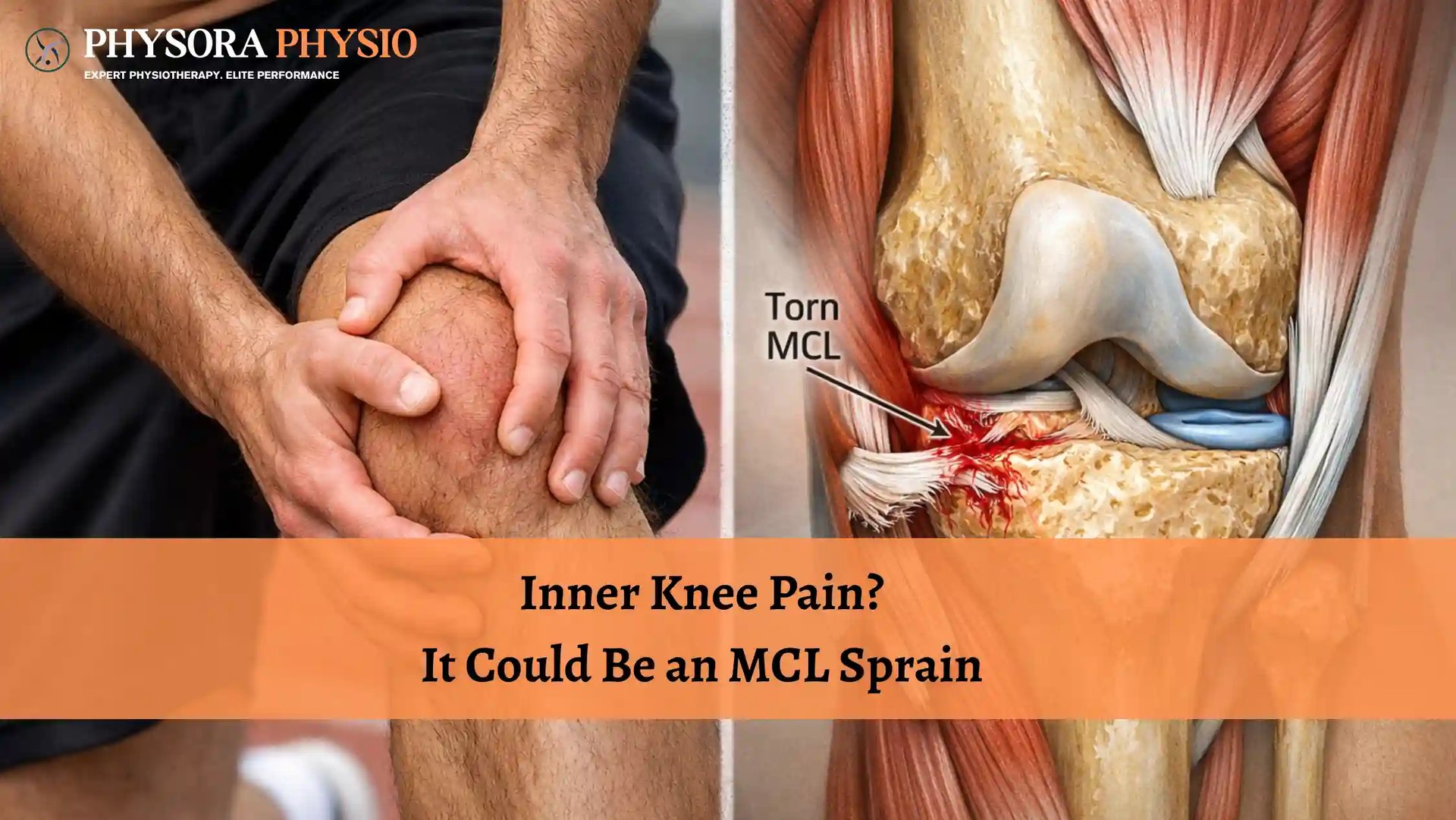
MCL Sprain: What It Is, How Long It Takes to Heal, and How Physiotherapy Helps
It happens in a split second. A studded boot plants awkwardly, another player clips the outside of your knee, or your foot catches in the turf as your body twists the other way. There’s a pull on the inside of your knee, sometimes a pop, sometimes just a deep, uneasy stretch, and suddenly you’re not sure whether to keep playing or stop dead.
The patient's story is a fictional example created for educational purposes, based on common physiotherapy scenarios.
Rhys, a 34-year-old five-a-side regular from Neath, felt exactly this during a Tuesday night match. He carried on for another ten minutes before the inside of his knee began to throb. By the next morning, it was swollen, tender to the touch along the inner joint line, and uncomfortable to twist. A quick search told him everything from “it’s nothing” to “you might need surgery”, which, understandably, left him more confused than before. What Rhys had was a medial collateral ligament (MCL) sprain, one of the most common knee ligament injuries seen in sports and active adults.
What Is the MCL, and How Does It Get Injured?
The medial collateral ligament runs along the inner side of your knee, connecting your thigh bone (femur) to your shin bone (tibia). Its main job is to resist valgus force, the inward-bending stress that occurs when the knee is pushed sideways while the foot stays planted. This is exactly what happens with a direct blow to the outside of the knee, a sudden change of direction, or an awkward twist on a fixed foot, common in football, rugby, skiing, and running on uneven ground.
When that sideways force exceeds what the ligament fibres can absorb, the MCL stretches or tears. This is graded by how much the ligament has been damaged, not simply by how much pain you feel, which is why two people with very different pain levels can have the same grade of injury, and vice versa.
Grading an MCL Sprain: Why “Just a Sprain” Isn’t Always Simple
Physiotherapists and clinicians typically use a three-grade system, assessed clinically with a valgus stress test at 30 degrees of knee bend:
Grade I (mild): Minimal fibre stretching, tenderness along the inner knee, but a firm, stable end-feel with no significant joint opening. Usually, minimal swelling and a full range of movement are often preserved.
Grade II (moderate): A partial tear with more noticeable joint laxity but still a definite endpoint when the ligament is stressed. Pain, swelling, and some sense of instability are more common.
Grade III (severe): A complete tear with little to no firm endpoint on testing. This carries a meaningfully higher chance of instability and is far more likely to involve other structures, particularly the ACL, which is why professional assessment matters even when a sprain “feels manageable.”
This last point matters more than most people realise. Clinical research on knee ligament injuries has shown that as valgus laxity increases, the likelihood of an associated ACL injury rises substantially from around one in five cases with no laxity on testing, up to the majority of cases where laxity is present with the knee fully straight. This is one of the main reasons a proper physiotherapy or medical assessment is worthwhile, even for an injury that “feels like just a sprain.”
How Physora Physio Assesses an MCL Sprain
At Physora Physio, an MCL assessment isn’t just about confirming “yes, it’s your MCL.” It involves:
A detailed history of how the injury happened (the mechanism tells us a lot about severity and what else might be involved)
Palpation along the ligament to localise tenderness
Valgus stress testing at different knee angles to grade the injury and check the quality of the “end-feel”
Screening the ACL, meniscus, and lateral structures, since MCL injuries rarely travel alone in more significant cases
A discussion of your goals, a desk worker returning to daily walking has a different rehab priority than a runner or gym-goer targeting a return to sport
If there’s any concern about a more complex injury (locking, significant instability, or a Grade III presentation), we’ll guide you on whether imaging or an orthopaedic opinion is appropriate alongside physiotherapy.
Realistic Recovery Timelines by Grade
Recovery timeframes vary between individuals, but general ranges reported in the clinical literature are:
Grade I: Often 2–4 weeks to return to normal daily activity, with sport-specific loading progressing shortly after.
Grade II: Typically 4–8 weeks, often supported by a hinged knee brace in the earlier phase for protection during healing.
Grade III: Can take up to around 8–12 weeks or longer, particularly where there is associated instability or another structure is involved.
Evidence is mixed on precisely how long bracing should continue and exactly when return-to-sport should occur. This genuinely depends on grade, sport demands, and how your knee responds to loading, which is why timelines should be treated as a guide rather than a fixed countdown and reviewed by a physiotherapist as you progress.
Evidence-Based Physiotherapy: What Actually Helps Recovery
Current research on MCL management points to a few consistent themes:
1. Movement, not prolonged rest. Older approaches favoured immobilisation, but evidence indicates that prolonged immobilisation can actually weaken healing ligament tissue over time. Controlled, early range-of-motion work started as soon as it’s safely tolerated is now favoured over long periods of stillness.
2. Bracing has a role, but it’s time-limited. For Grade II and III sprains, a hinged knee brace is commonly used in the early weeks to limit sideways stress on the healing ligament while still allowing bending and straightening. Grade I sprains often don’t need one at all. Bracing is generally a short-term protective tool, not a long-term crutch.
3. Early quadriceps activation matters. Simple work like straight-leg raises and quad activation exercises is typically introduced early to prevent the muscle weakness that so often follows knee injury and slows the whole recovery down.
4. Rehab should be personalised, not templated. A recent systematic review of non-surgical MCL management specifically highlighted that “one-size-fits-all” protocols don’t reflect good practice; your rehab plan should reflect your grade of injury, your sport or lifestyle demands, and how your strength and range of movement are actually progressing, not a generic calendar.
5. Proprioception and control come before return to sport. Balance and joint-position-sense training (think single-leg standing progressions, controlled landing and cutting drills) helps rebuild the knee’s ability to react to sudden sideways forces, the very mechanism that caused the injury in the first place.
Common Mistakes That Slow MCL Recovery Down
Returning to sport on pain alone, without objectively testing strength and control
Avoiding all movement out of fear, which can stiffen the knee and delay healing
Skipping quad and hip strengthening, focusing only on “resting the ligament”
Ignoring a Grade II or III injury because walking still feels possible, many patients can walk on a significant MCL sprain, which is exactly why self-assessment alone isn’t reliable
Preventing Re-Injury: Building a Resilient Knee
Once symptoms settle, prevention work matters just as much as the initial rehab. This typically includes progressive strengthening of the quadriceps, hamstrings, and hip muscles, movement control drills for cutting and change-of-direction sports, and, where relevant, technique review for running or training surfaces that may have contributed to the original injury.
When to Seek Professional Assessment
Book an assessment promptly if you notice:
A feeling of the knee “giving way” or genuine instability
Significant swelling within hours of injury
Difficulty bearing weight at all
Pain that isn’t settling within the first week
Any sense that something “isn’t right” beyond typical sprain discomfort
Even mild, nagging inner-knee pain after a twisting injury is worth having checked early; accurate grading means a more confident, efficient recovery.
Frequently Asked Questions
Can you walk with an MCL sprain?
Often, yes, even with a moderate sprain. Being able to walk doesn’t rule out a significant injury, so it shouldn’t be used alone to judge severity.
Do I need a brace for an MCL sprain?
Not always. Grade I sprains often don’t require one, while Grade II and III injuries commonly benefit from a hinged brace for a period of weeks, based on assessment.
How do I know if I’ve torn my MCL rather than something else?
Tenderness specifically along the inner joint line, pain with a sideways stress test, and a mechanism involving a valgus (inward-bending) force are typical signs, but only a clinical assessment can confirm this and rule out associated ACL or meniscus involvement.
When can I return to sport after an MCL sprain?
This depends on grade, healing progress, and how your knee performs on strength and control testing, ranging from a couple of weeks for mild sprains to several months for more complex injuries. A physiotherapist can guide a safe, criteria-based return to sport rather than a fixed date.
Does an MCL sprain need surgery?
The majority of isolated MCL injuries, including many complete tears, are managed successfully without surgery through structured, progressive physiotherapy. Surgery tends to be reserved for cases with persistent instability or significant multi-ligament injury.
Ready to Get Your Knee Moving Again?
Whether your MCL injury happened on the pitch, the trail, or simply from an awkward step, getting an accurate grade and a personalised rehab plan early makes a real difference to how quickly and confidently you recover.
Physora Physio’s Neath clinic offers assessment-led physiotherapy for sports and joint injuries, with rehab built around your body and your goals, not a generic checklist.
Book your MCL knee assessment with Physora Physio in Neath today.
References
American Physical Therapy Association, Orthopaedic Section. (n.d.). Clinical practice guideline: Knee ligament sprain. Journal of Orthopaedic & Sports Physical Therapy. (Please verify publication year, volume, issue, pages, and DOI.)
Indelicato, P. A., Hermansdorfer, J., & Huegel, M. (2021). Medial collateral ligament injury of the knee: Current concept and management. (Please verify journal name, volume, issue, pages, and DOI.)
BMJ Open Sport & Exercise Medicine. (n.d.). Systematic review of non-surgical management of medial collateral ligament (MCL) injuries. (Please verify authors, publication year, volume, issue, pages, and DOI.)
Clinical grading literature on valgus stress testing at 30° of knee flexion. (n.d.). (Please verify the original publication details and format according to APA 7th edition.)


Copyright © 2025 Physora Physio
Useful links
PHYSORA PHYSIO
Expert Physiotherapy.
Elite Performance
Get in Touch
Treatments
Plan Your Visit
About Us
Insights