
Persistent Deep Glute Pain in Runners: Understanding Proximal Hamstring Tendinopathy
Persistent deep glute pain when running or sitting may be proximal hamstring tendinopathy. Learn symptoms, causes, and evidence-based treatment for runners.
Paul Antony
4/15/20264 min read
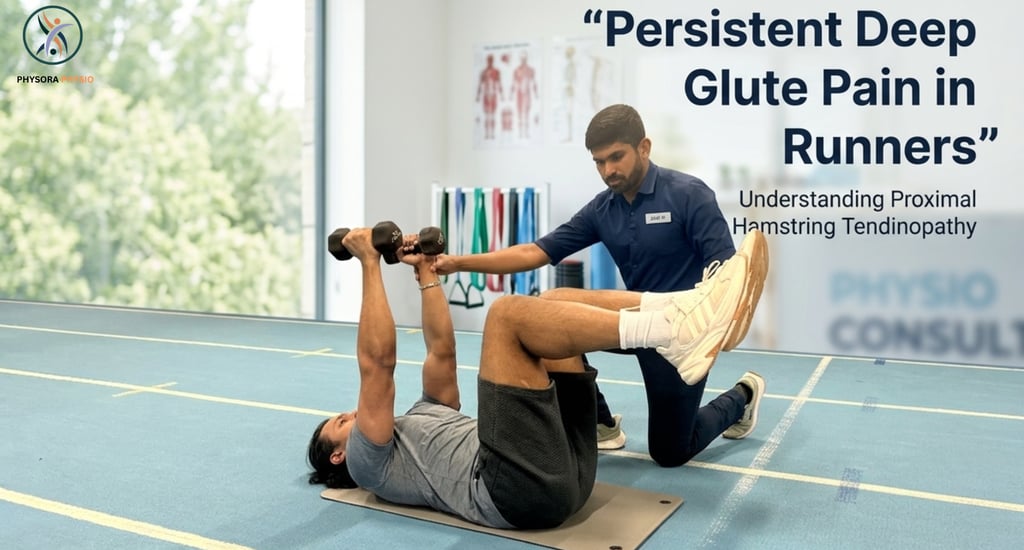

That Deep Glute Pain That Won’t Go Away? It Might Not Be Your Back…
A persistent ache deep under the glute that continues to return despite rest, stretching, and foam rolling is a common presentation in runners and is often not related to simple muscle tightness.
In many cases, this pattern is associated with proximal hamstring tendinopathy, a running-related overuse injury involving irritation of the hamstring tendon at its attachment to the sitting bone.
The condition typically presents with symptoms that fluctuate with running load, sometimes easing with short rest periods but recurring once training resumes.
At Physora Physio, we frequently assess runners with this exact presentation, particularly in those with changes in training volume, intensity, or hill running.
With accurate diagnosis and structured load management, this condition is highly treatable and recovery outcomes are generally very positive.
What Is Proximal Hamstring Tendinopathy?
Proximal hamstring tendinopathy is a condition where the hamstring tendon becomes irritated or overloaded right where it attaches to your sitting bone (ischial tuberosity).
Unlike a muscle strain, this is not a sudden injury.
It’s a gradual overload problem meaning the tendon has been under more stress than it can recover from over time.
And that’s exactly why it becomes so frustrating for runners: it doesn’t just “heal with rest” the way many expect.
Common Symptoms Runners Notice
Most runners don’t realise what they’re dealing with at first. It usually starts subtly and builds over time.
Typical symptoms include:
A deep ache in the lower glute or upper hamstring
Pain or discomfort when sitting for long periods
Pain during running, especially faster runs or hill work
Stiffness at the start of a run that may ease, then return later
A “nagging” pain that keeps coming back despite rest
One of the most frustrating parts? It often feels better temporarily, only to flare up again when you return to running normally.
Why Runners Are So Prone to This Injury
Running is repetitive by nature and your hamstrings work extremely hard every single stride.
They play two key roles:
Extending your hip when you push off
Controlling your leg as it swings forward
This means the tendon is constantly under tension, especially during:
Faster running
Hill running
Sudden increases in mileage
Now add a few common training issues:
Overstriding (landing too far in front of your body)
Weak or underactive glutes
Poor recovery between sessions
Sudden spikes in training load
Over time, the tendon simply becomes overloaded and starts to react.
Not injured in a dramatic way—but irritated, sensitive, and increasingly painful.
A Runner’s Experience (Very Common Scenario)
Take Sarah, for example.
She’s a recreational runner training for her first half marathon.
At first, she notices a dull ache in her glute after long runs. Nothing serious—just a bit of discomfort.
So she ignores it.
But over the next few weeks, things change.
Sitting at work starts to feel uncomfortable.
Then easy runs begin to trigger the pain.
So she does what many runners do—she stretches more.
But instead of improving, the pain gets worse.
Why?
Because in tendon-related issues, aggressive stretching can actually irritate the area further, especially where the tendon attaches.
This is where most runners accidentally go wrong.
Why Stretching Alone Doesn’t Fix It
If you’re dealing with proximal hamstring tendinopathy, stretching often feels like the right thing to do—but it usually isn’t enough.
In many cases, it can even make symptoms worse.
Here’s why:
Stretching can compress the irritated tendon
Rest alone reduces strength and load tolerance
Running through pain increases overload
So the real issue doesn’t improve—it just keeps cycling.
What the tendon actually needs is something different…
Progressive, controlled loading.
What Actually Works (Evidence-Based Approach)
Modern physiotherapy focuses on building the tendon’s capacity again—not just reducing pain temporarily.
Here’s what actually helps:
1. Smart Load Management
You don’t need to stop running completely—but you do need to modify it.
This might include:
Reducing weekly mileage temporarily
Avoiding hills and speed work for a short phase
Adjusting sitting time if it aggravates symptoms
The goal is simple: reduce irritation while keeping the tendon active.
2. Targeted Strength Work
This is the most important part of recovery.
We gradually rebuild the tendon’s strength using exercises such as:
Isometric hamstring holds
Romanian deadlifts (RDLs)
Glute bridges and progressions
These exercises help the tendon adapt, strengthen, and tolerate load again.
Over time, this reduces pain and improves performance.
3. Running Technique Adjustments
Small changes can make a big difference in reducing tendon stress:
Slightly increasing cadence
Avoiding overstriding
Improving hip stability during running
These adjustments reduce strain on the hamstring tendon with every step.
4. Gradual Return to Running
This is where many runners rush—and end up back at square one.
A structured return-to-run plan ensures:
The tendon adapts progressively
Flare-ups are minimised
Long-term recovery is achieved (not just short-term relief)
Consistency here is key.
When Should You Get It Checked?
If you’ve been dealing with:
Pain lasting more than 2–3 weeks
Symptoms that keep returning
Discomfort while sitting or during daily activities
…it’s time to get it properly assessed.
The longer it lingers, the more sensitive the tendon can become—but early intervention usually leads to much faster recovery.
Why Runners Trust Physora Physio
At Physora Physio, we specialise in treating runners and running-related injuries.
We don’t just treat the pain—we look at:
How you move
How you train
Why the overload is happening in the first place
Every assessment is tailored, biomechanical, and focused on long-term recovery—not just quick fixes.
We work with runners every day who want to get back stronger, not just pain-free.
Take the First Step Back to Pain-Free Running
If this pain has been holding you back, ignoring it won’t make it go away.
But the right approach absolutely can.
With the correct rehab plan, most runners return to full training stronger, more resilient, and more aware of their movement than before.
Book an assessment with Physora Physio today
and take the first real step toward pain-free running.
FAQs
Is proximal hamstring tendinopathy serious?
It’s not dangerous, but it can become long-term if ignored. Early treatment leads to much better outcomes.
Can I still run with hamstring tendon pain?
Yes, in most cases but it needs to be modified and guided properly.
How long does recovery take?
Typically 6–12 weeks depending on severity and consistency with rehab.
Should I stretch my hamstrings?
Not aggressively. In many cases, it can worsen symptoms.
Do I need physiotherapy?
If symptoms persist, physiotherapy significantly improves recovery by addressing the root cause, not just pain.


Copyright © 2025 Physora Physio
Useful links
PHYSORA PHYSIO
Expert Physiotherapy.
Elite Performance
Get in Touch
Treatments
Plan Your Visit
About Us
Insights