
Why the Bench Press Hurts Your Shoulder - A Guide to Pain-Free Pressing
Bench pressing shouldn’t hurt your shoulders. This guide breaks down why shoulder pain notice bench press, common mistakes, and how to fix your form for pain-free, stronger pressing.
Paul Antony
1/2/20263 min read
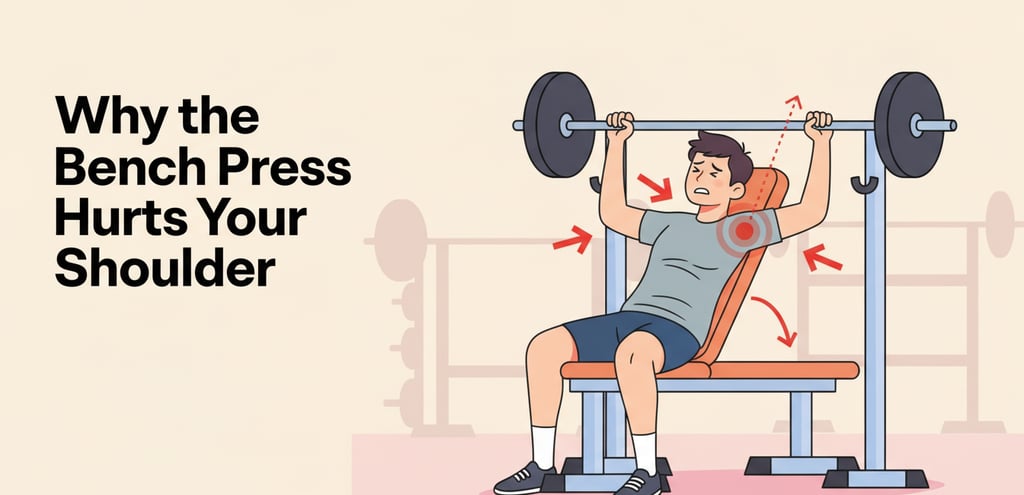
For many fitness enthusiasts in our local community, the bench press is the "King" of upper-body exercises. But it is also a notorious culprit for shoulder pain. If you’ve been feeling a sharp pinch during your heavy sets or a dull ache the next morning, you aren't alone.
At Physora Physio, we treat everyone from casual gym-goers at the local leisure centres to competitive lifters. We know that "just resting" isn't the answer you want. To fix the pain, we first have to understand the fascinating biomechanics of why the bench press is so demanding on the shoulder joint.
The "Perfect Storm": Why the Shoulder is Vulnerable
The shoulder (the glenohumeral joint) is a ball-and-socket joint, but it’s often described as a "golf ball on a tee." This design allows for an incredible range of motion, but it relies heavily on muscles and ligaments for stability. When you lie flat on a bench and lower a heavy bar to your chest, you are putting this delicate balance to the test.
The Biomechanical Reasons for Bench Press Pain
1. Scapular Blockage (The "Fixed" Shoulder Blade)
In a natural pushing movement, like a push-up, your shoulder blades (scapulae) are free to move. As you push, they slide forward; as you lower, they retract.
The Problem: When you lie on a weight bench, your shoulder blades are "pinned" against the upholstery by your body weight and the bar's load.
The Consequence: This restricts the natural rhythm of the shoulder. If the shoulder blade can’t move, the "ball" of your arm bone (humerus) has to shift excessively within the socket, often leading to irritation of the bursa or tendons.
2. Internal Rotation and Impingement
Most lifters use a wide, overhand grip. As the bar descends toward the chest, the elbows often flare out.
The Science: This "flared" position puts the shoulder into a state of maximal internal rotation under heavy load.
The Consequence: This narrows the subacromial space—a tiny gap where your rotator cuff tendons live. Biomechanical studies show that this "impingement" can pinch the supraspinatus tendon, leading to inflammation and that classic sharp pain at the bottom of the lift.
3. The "Horizontal Abduction" Stress
When the bar touches your chest, your elbows are often deep behind your torso.
The Science: This position puts the anterior (front) capsule of the shoulder under extreme tension.
The Consequence: If your rotator cuff isn't strong enough to pull the ball back into the socket, the humerus slides forward, putting immense pressure on the long head of the biceps tendon and the labrum.
4 Pro-Tips for Pain-Free Pressing
You don't have to give up the bench press. You just need to adjust the mechanics.
The "Tuck" Technique: Instead of flaring your elbows at 90 degrees, tuck them in slightly (about 45–75 degrees from your body). This opens up the subacromial space and protects the rotator cuff.
Retract and Depress: Before you even unrack the bar, imagine tucking your shoulder blades into your back pockets. This creates a stable "platform" and protects the front of the joint.
Try the Dumbbell Alternative: If the barbell feels too restrictive, switch to dumbbells. They allow your wrists and elbows to move in a more natural, neutral path, which reduces the "scapular blockage" mentioned earlier.
Frequently Asked Questions (FAQs)
Should I stop benching if my shoulder hurts?
Not necessarily. Pain is a signal, not always a sign of damage. At Physora Physio, we usually recommend "modifying" rather than "stopping." This might mean reducing the range of motion (using a board press) or switching to a floor press to limit the depth.
Is it my rotator cuff or something else?
While the rotator cuff is common, pain can also come from the AC joint (the bump on top of your shoulder) or the biceps tendon. A professional assessment at our clinic can pinpoint the exact structure causing the issue.
Can stretching my chest help?
Yes! Biomechanically, if your pec minor is tight, it pulls your shoulder blade forward and down, which makes impingement more likely. Stretching the chest helps the shoulder blade sit in a better position.
Recovery and Performance at Physora Physio
If you’ve been ignoring that "niggle" in your shoulder, it’s time to take action before it becomes a chronic injury. At our Neath clinic, we specialise in sports biomechanics. We don't just treat the symptoms; we analyse your lifting form, check for muscular imbalances, and give you a bulletproof rehab plan.
Whether you're training at a local gym or preparing for a competition, our goal is to get you back under the bar with total confidence.
Ready to fix your shoulder and smash your PB?
Book Your Appointment at Physora Physio Today


Copyright © 2025 Physora Physio
Useful links
PHYSORA PHYSIO
Expert Physiotherapy.
Elite Performance
Get in Touch
Treatments
Plan Your Visit
About Us
Insights